Scaleup
Prototype to Production: Where Hardware Margins Get Decided

Anthony Occidentale and Alex LaDouceur
· 5 min read
A working prototype proves your team can build the product once. Margin gets decided later, by the production system around the design: supplier quotes, first-pass yield, test time, labor and the handoffs between the people who own each one. Plan that system before you set your price, and treat every pre-production build as a cost review.
Coolest Cooler priced its pledges before costing production
Between July 8 and August 29, 2014, the Coolest Cooler raised $13,285,226 from 62,642 Kickstarter backers, then a record for the platform, Time reported. Most backers pledged $185 for a cooler with a built-in blender, a Bluetooth speaker and a USB charger, and early backers paid as little as $165.
Two years later the money had run short. Founder Ryan Grepper wrote to backers on April 12, 2016 that "we didn't set the pledge levels high enough to cover the final quality of the Coolest Cooler." Fox News reported that Grepper "blamed the delay on a strike at a blender motor factory in China." The company asked waiting backers for another $97 to ship sooner, and by April 2016 Amazon listed the cooler at $399.99.
The company closed in December 2019, citing tariffs on imports from China. GeekWire reported that the shutdown left about 20,000 backers without their reward, eligible for at most $20 each under a 2017 Oregon Department of Justice agreement. Roughly 42,000 backers did receive a cooler, so the design could be built. The pledge price had been set before anyone costed building it at volume.
Two common rules of thumb break at scale
Two pieces of advice dominate early hardware planning. First, design the parts for manufacturing (DFM), then hand them to a contract manufacturer (CM) who handles the rest. Second, expect unit cost to fall as volume grows.
Both are partly right. Both fail when founders treat them as the whole plan.
Most startup cost guides stop at one-time items such as tooling and certification. Margin is set later, by first-pass yield, test time and touch labor on every unit.
DFM covers the parts. Margin depends on the process around them: how many units pass test the first time, how long test takes, how many people touch each unit, what freight and duty add, and how fast design changes reach the line. A CM quotes what you ask it to quote, and it prices in the risks you haven't named.
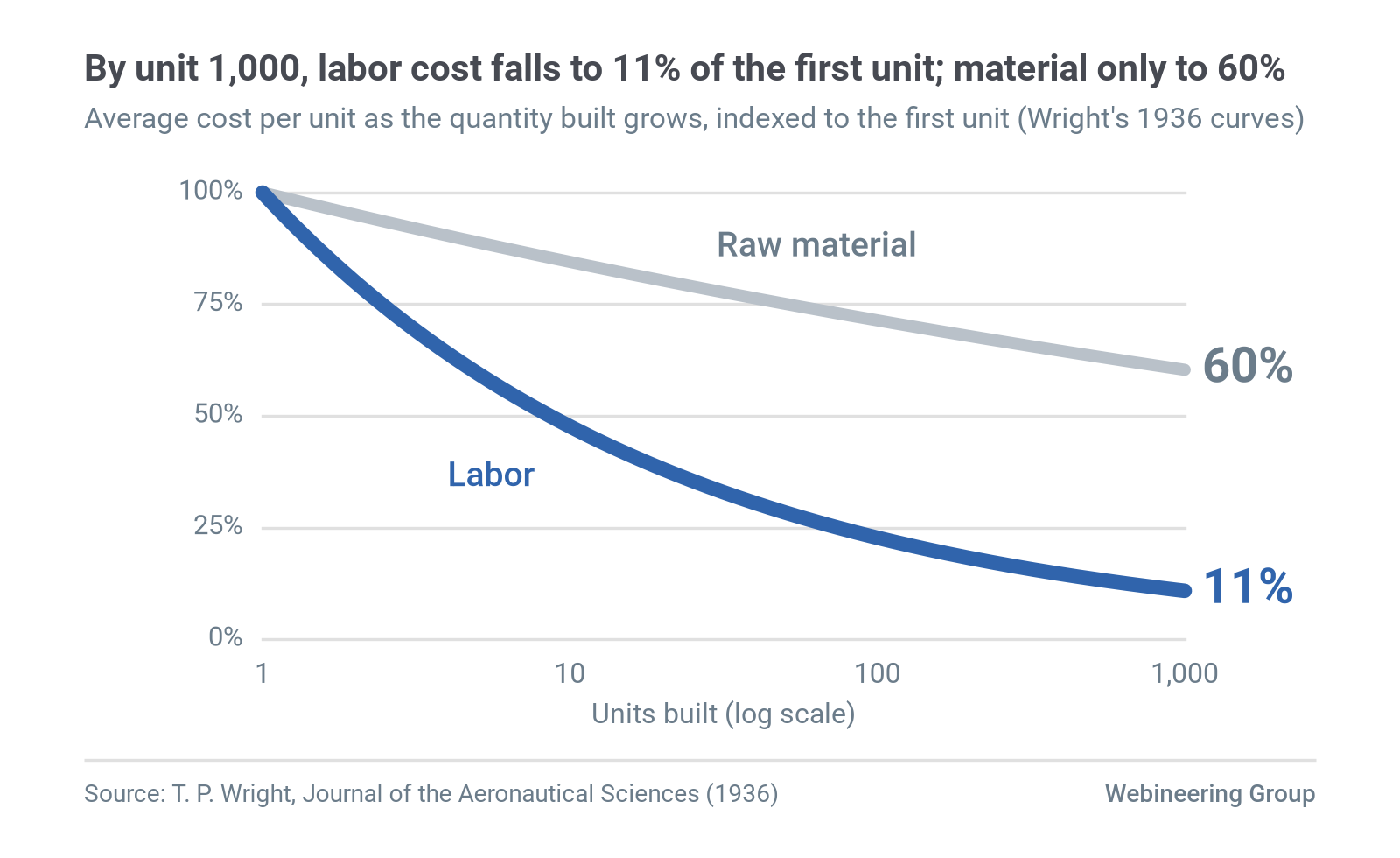
Volume lowers cost when the process learns. T. P. Wright's 1936 study of airplane costs found that average labor cost fell to 80% of its prior level each time the quantity built doubled (Journal of the Aeronautical Sciences). Raw material followed a much flatter 95% curve. Wright also assumed "no major changes will be introduced during construction."
That fine print matters for startups. A process that changes every week stays off the curve, and material, freight and duty barely move with volume.
Independent research points the same way. At the CHI 2020 conference, Rushil Khurana of Carnegie Mellon and Steve Hodges of Microsoft Research reported interviews with 25 people who took prototype hardware into low-volume production. They found that "creating hundreds or thousands of exact replicas" was "still challenging for many."
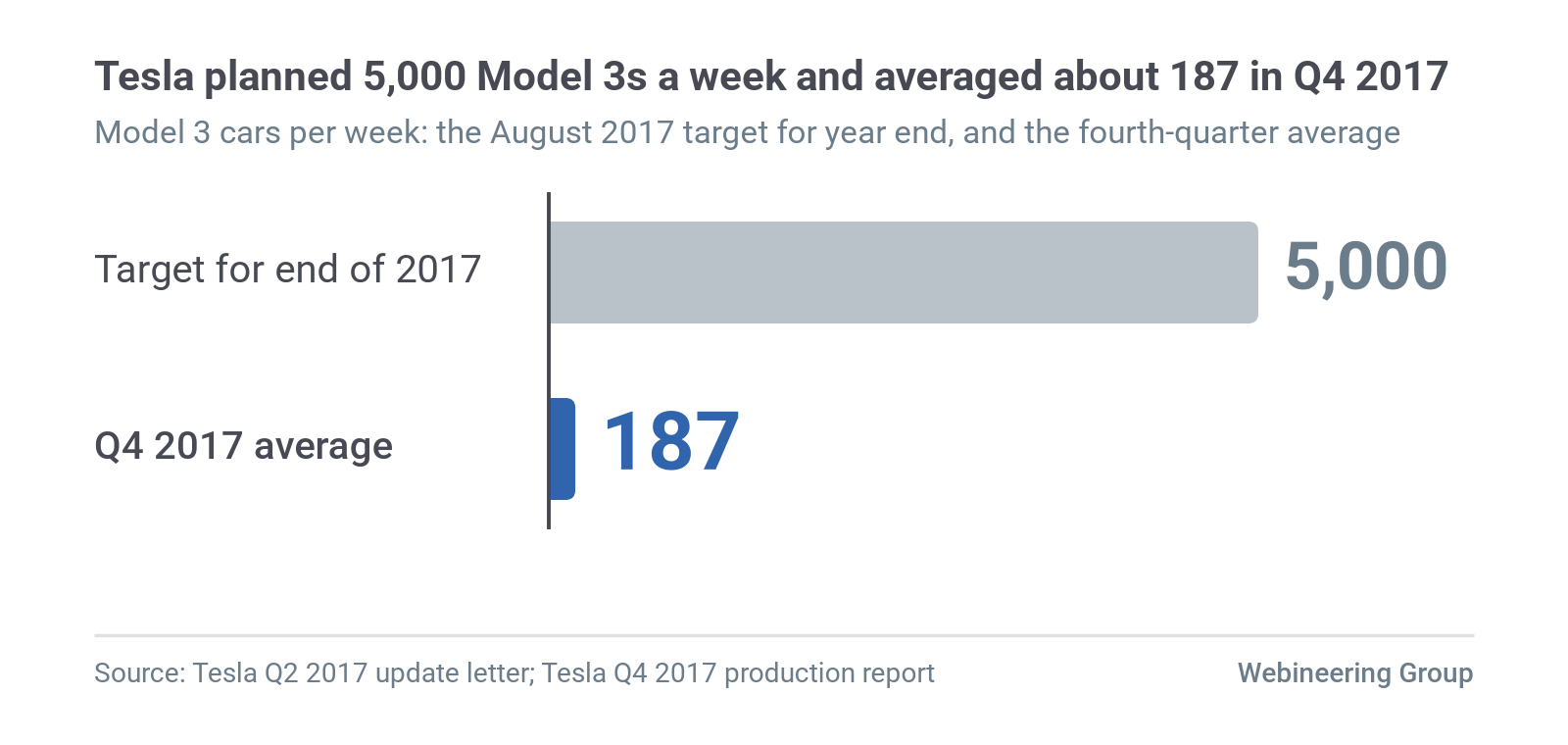
Well-funded teams hit this too. In August 2017, Tesla told shareholders it was confident it could "achieve a run rate of 5,000 vehicles per week by the end of 2017." It built 2,425 Model 3s in the whole fourth quarter, or about 187 a week over its 13 weeks, against that 5,000 target. Elon Musk told CBS News in April 2018 that the company had put "too much new technology into the Model 3 all at once," and that it "should have been staged."
Five costs decide margin before the first production run
- First-pass yield. Every unit that fails test costs its materials, its labor and the time spent diagnosing it. At 85% first-pass yield, about one unit in seven needs rework or scrap.
- Test time. At eight minutes of final test per unit and 400 units a week, test alone needs more than 53 hours of station time weekly.
- Touch labor. Count how many people handle each unit between receiving and shipping, and for how many minutes. Wright's data say this is the cost most likely to fall with repetition.
- Landed cost. Freight, duty and tariffs land on every unit. Coolest Cooler's final note to backers named tariffs as the reason it closed.
- Change cost. Each design change after tooling means new parts, scrapped stock and rewritten work instructions. It also resets the learning Wright measured.
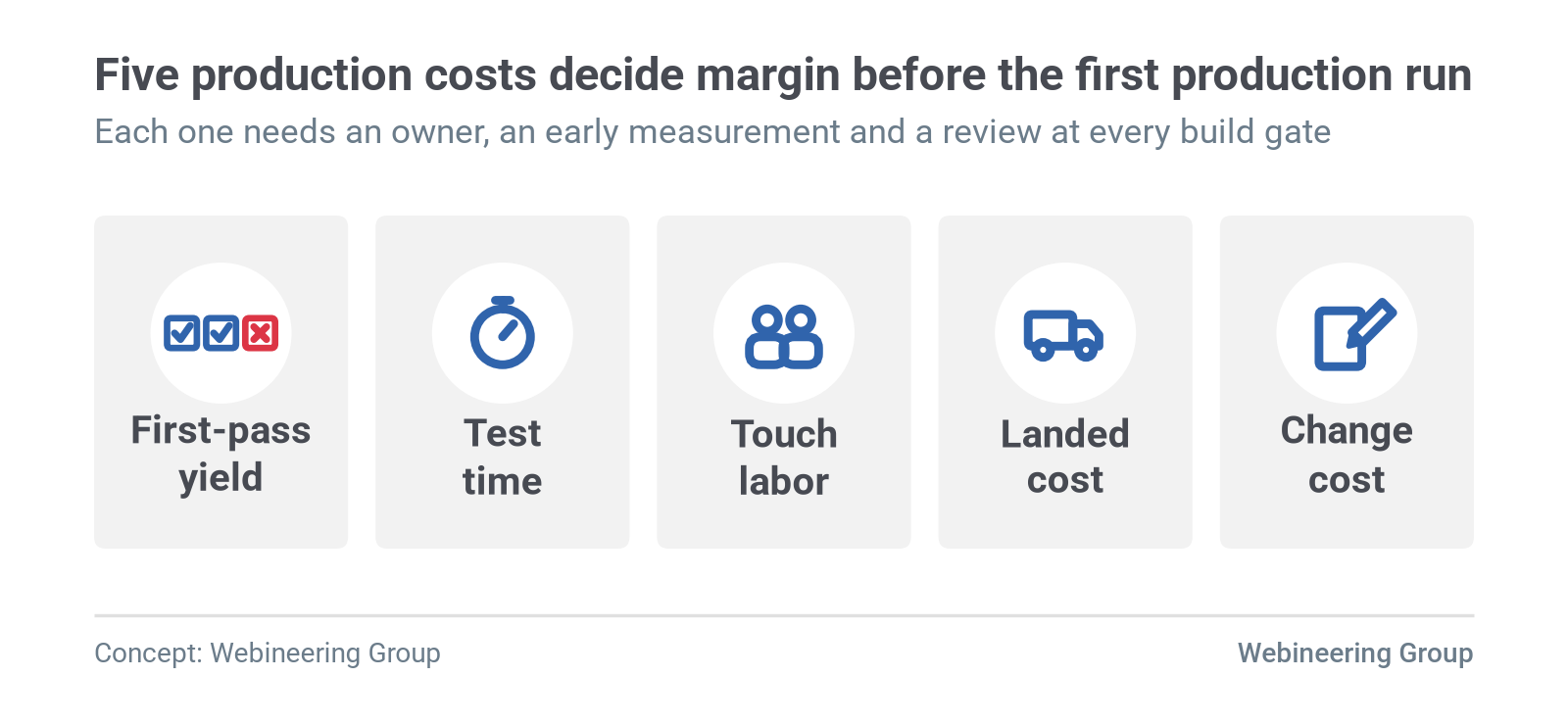
Engineering skill touches all five, and the design alone settles none of them. Each needs an owner, an early measurement and a review at every build gate.
Build gates work as cost reviews
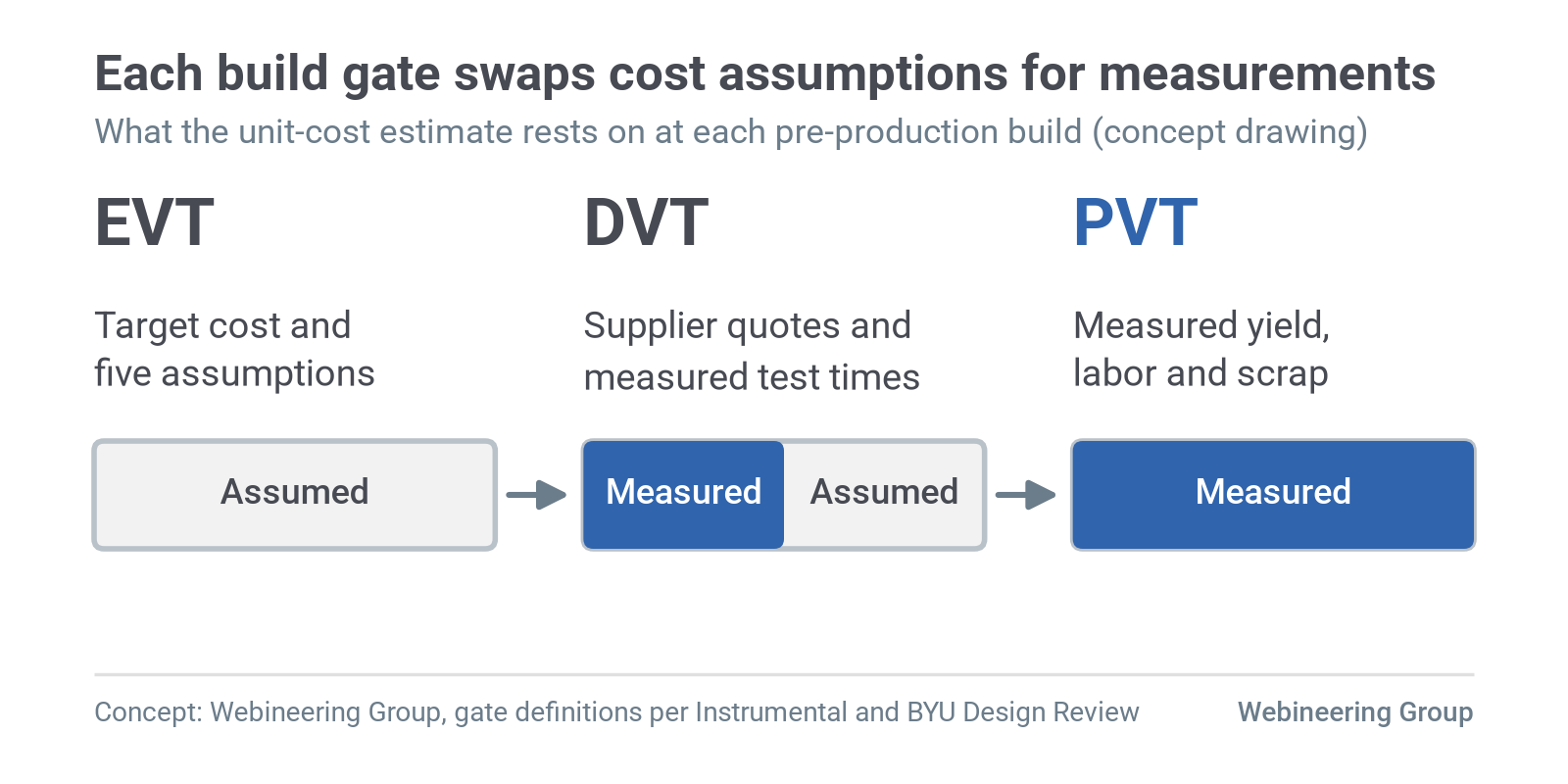
Most hardware teams run three builds before production. Engineering validation test (EVT) is the first build to combine the looks-like and works-like prototypes in one form, using production-intent materials and processes. Design validation test (DVT) builds one production-worthy design from hard-tooled parts on a line that follows production procedures, so the team can measure real yields. Production validation test (PVT) is the last build before ramp, and its units are meant for sale if they pass every test station.
Use each gate to replace assumptions with measurements:
- At EVT, write down the target unit cost and the five assumptions behind it.
- At DVT, swap those assumptions for supplier quotes and measured test times.
- At PVT, measure first-pass yield, labor minutes and scrap on real runs, and reprice if the numbers say so.
Work instructions belong in this plan. Picture a startup whose prototypes all passed because the two engineers who designed the board built every one. The production technicians weren't in the room, so the instructions have to carry what those engineers knew. One practical check: hand a new technician the instructions and see whether they can build a passing unit without help.
Three conditions change the advice
- Simple enclosures around proven modules. If the hardware is an off-the-shelf module in a molded case, cost comes mostly from the bill of materials and the CM's quote, and production-system risk shrinks.
- Very low volume. At a few dozen units a year built by the engineering team, margin depends on pricing and engineering time, and formal build gates may add overhead you don't need yet.
- High-volume consumer electronics. At hundreds of thousands of units, cost depends on factory economics and supplier bargaining power this article doesn't cover.
Monday: put numbers on the gaps
- Write your target unit cost and the five assumptions it depends on, on one page.
- Ask your CM to state its first-pass yield and test-time assumptions in writing.
- Time one full build of your current unit, including test and packing.
- List every design change since your last build and what each one cost.
- Hand the current instructions to a technician who didn't design the product, and watch them build one.
Independent review before your next build
If you're between prototype and production, our fixed-fee site assessment reviews your build plan, your CM's assumptions and the gaps between them. You get a ranked list of what to fix before the next build. To find the gaps yourself first, the free Prototype to Production Readiness Check rebuilds your unit cost at your first-run volume, checks eight scaleup areas from suppliers to work instructions, and gives you a ranked list of what to fix first.
Site assessment
Want to see where your own line stands?
An evidence-backed report on where real value lies, from the people who stay through implementation.
About the authors
Alex LaDouceur
Founder
Alex has led Webineering since it started in 2022. At DuPont's Circleville plant he held senior engineering and engineering management roles on the $250 million Kapton and Pyralux expansion, a continuous web line taken from design to qualified production. At Schlumberger he was responsible for assembly, test and refurbishment across deepwater completions product lines.