The pilot line today
One coating line, one lamination press, one shift of 18
- Good modules shipped, last 12 months
- About 180
- Capacity for good modules
- About 1,200 a year
- Cost per good module
- $2,850
Case study · Sample site assessment
A Series B water-technology startup had its first commercial order and a $4.2M plan to scale. Only 42% of the modules its pilot line started passed final test. Our site assessment laid out a yield-first path to 5,000 modules a year, seven months sooner and with $1.6M of capital deferred.
Sample deliverable. This case study and report are a composite. Company names, people, locations, and figures have been changed to protect client confidentiality.
| Category | Modules |
|---|---|
| Passed final test | 42 |
| Lost at lamination | 35 |
| Lost at the other five steps | 23 |
The situation
Tessaline makes spiral-wound membrane modules for industrial water reuse. Its pilot line proved the product. Its first commercial order needs ten times the output, from the same line and the same small team.
One coating line, one lamination press, one shift of 18
An anchor customer for industrial water reuse, with a pipeline behind it
Can our pilot line get to 5,000 modules a year, and is our capital plan the right way there?
Asked by the CEO and co-founder, with two follow-on questions:
What we found
Four views of the same pilot line, from the yield numbers to the capital plan.
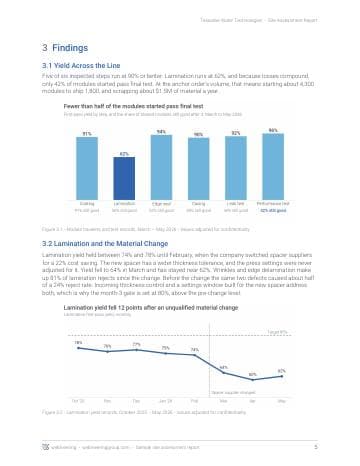
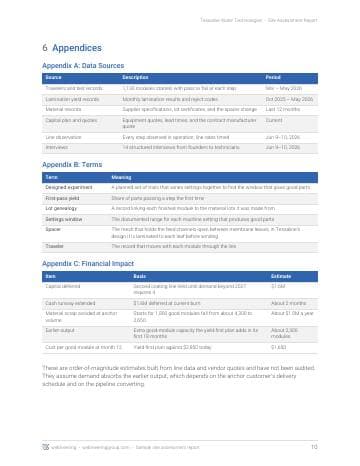
Five of six inspected steps run at 90% or better. Lamination runs at 62%, and because losses compound, only 42% of modules started pass final test. At the anchor order's volume that means scrapping about $1.5M of material a year.
Lamination yield held near 76% until February, when a new spacer supplier cut material cost by 22%. The press settings were never adjusted for its wider thickness tolerance. The change saves about $15 a module and costs about $270 per good module in scrap.
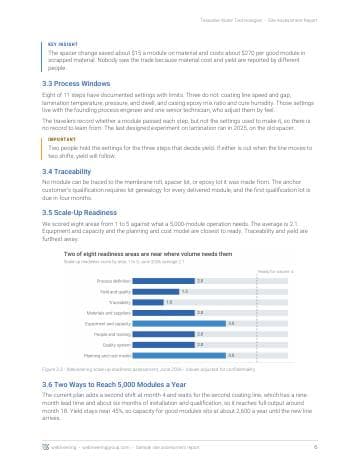
We scored eight areas against what a 5,000-module operation needs. The average is 2.1 of 5. Equipment and planning are closest. Traceability and yield are furthest away, and three steps run on settings two people hold from memory.
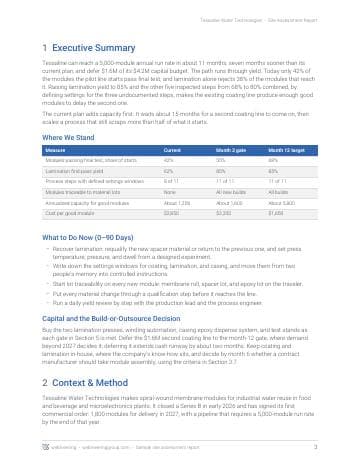
The current plan waits about 15 months for a second coating line to come on and scales a process that scraps more than half of what it starts. Fixing yield first reaches 5,000 good modules a year at month 11 on the existing line.
Try the ramp
A simplified version of the ramp model in the report. Start from today, then compare the current capital-first plan with the yield-first plan.
Annualized capacity for modules that pass final test.
Short of the anchor order's 1,800 modules a year.
Assumes one coating line starts about 2,860 modules per shift a year, one lamination press handles up to 6,000 starts a year, $620 of material per start, and measured shift costs. Your model is built from your own line rates, yields, and quotes.
The plan
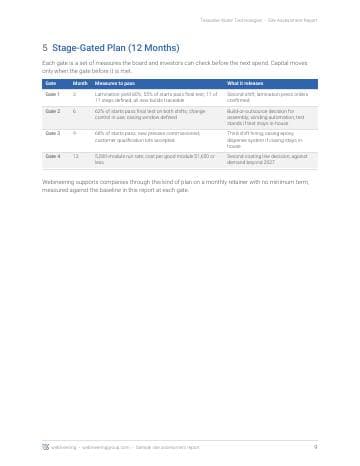
Each phase ends in a gate the board and investors can check before the next spend.
Lamination yield 80%, 55% of starts passing final test, 11 of 11 steps defined, and every new build traceable. Releases the second shift and the press orders.
The deliverable
A readiness scorecard, the ramp model, a build-or-outsource recommendation, and a stage-gated 12-month plan, written for the founders and the board.
How a site assessment runs
These are the Study and Outline stages of our S.O.L.V.E. framework.
You send travelers, test records, yield history, the capital plan, and any vendor or contract manufacturer quotes. We trace yield through every step.
We watch every step of the line in operation, time line rates, review settings and records, and interview the team from the founders to the technicians.
We score readiness, build the ramp model, and deliver the report with a 90-day plan and a stage-gated 12-month plan.
Next step
Sample deliverable. A composite, with names and figures changed to protect client confidentiality.