People
Why Change Initiatives Fail in Week Three

Anthony Occidentale and Alex LaDouceur
· 5 min read
Most new floor routines fade on a curve you could draw before launch. Launch week runs on attention, visits and novelty, and those supports are usually gone by week three. Habits take far longer to form than most rollout plans budget for.
A hypothetical rollout looks fine for two weeks
Picture a plant that launches leader standard work on a Monday. Each supervisor gets a laminated card with a daily line walk, a 2 p.m. check of the production board, and a weekly review of open actions.
In week one, the plant manager joins every walk and the operations director visits on Thursday. Cards come back complete. In week two, the plant manager misses two days for a customer visit, and nobody mentions the cards.
In week three, a line goes down at 1:45 p.m. on Tuesday. The supervisor skips the board check to deal with it, and the card stays blank. Nothing happens.
By week six, completion is around a third, and people start calling the routine "a bad fit for us." Templates for leader standard work are free and easy to find. The behavior behind the card needed more weeks than this plant gave it.
Template-first advice treats adoption as a paperwork task
Search for leader standard work implementation and the top results come mostly from software vendors. Their headings cover routines for each management level, six steps to define the work, and how to digitize it. They say little about week three.
The usual sustainment advice leans on urgency and a statistic: 70% of change initiatives fail. Mark Hughes of the University of Brighton traced that figure through five published sources in the Journal of Change Management in 2011. He found "no valid and reliable empirical evidence to support such a narrative."
Education researcher Michael Fullan offers a more useful frame. In Leading in a Culture of Change (2001, page 40), he wrote that "the implementation dip is literally a dip in performance and confidence as one encounters an innovation that requires new skills and new understandings."
A dip is normal. The trouble starts when the rollout plan ends before the dip does.
Habits need about 10 weeks, and rollout support lasts about two
Lally and colleagues asked 96 volunteers to repeat one new eating, drinking or exercise behavior daily in the same context, such as "after breakfast." They tracked how automatic it felt for 12 weeks and published the results in the European Journal of Social Psychology in 2010.
For the 39 participants whose data fit the model well, the median time to reach 95% of their peak automaticity was 66 days. The range ran from 18 to 254 days, and the study lasted 84 days, so the longest times were projections from each person's curve.
Benjamin Gardner, Lally and Jane Wardle later advised family doctors in the British Journal of General Practice in 2012. They wrote that "it may be helpful to tell patients to expect habit formation (based on daily repetition) to take around 10 weeks."
Most plant rollouts budget one or two weeks of heavy support. The routine dies in the space between those numbers.
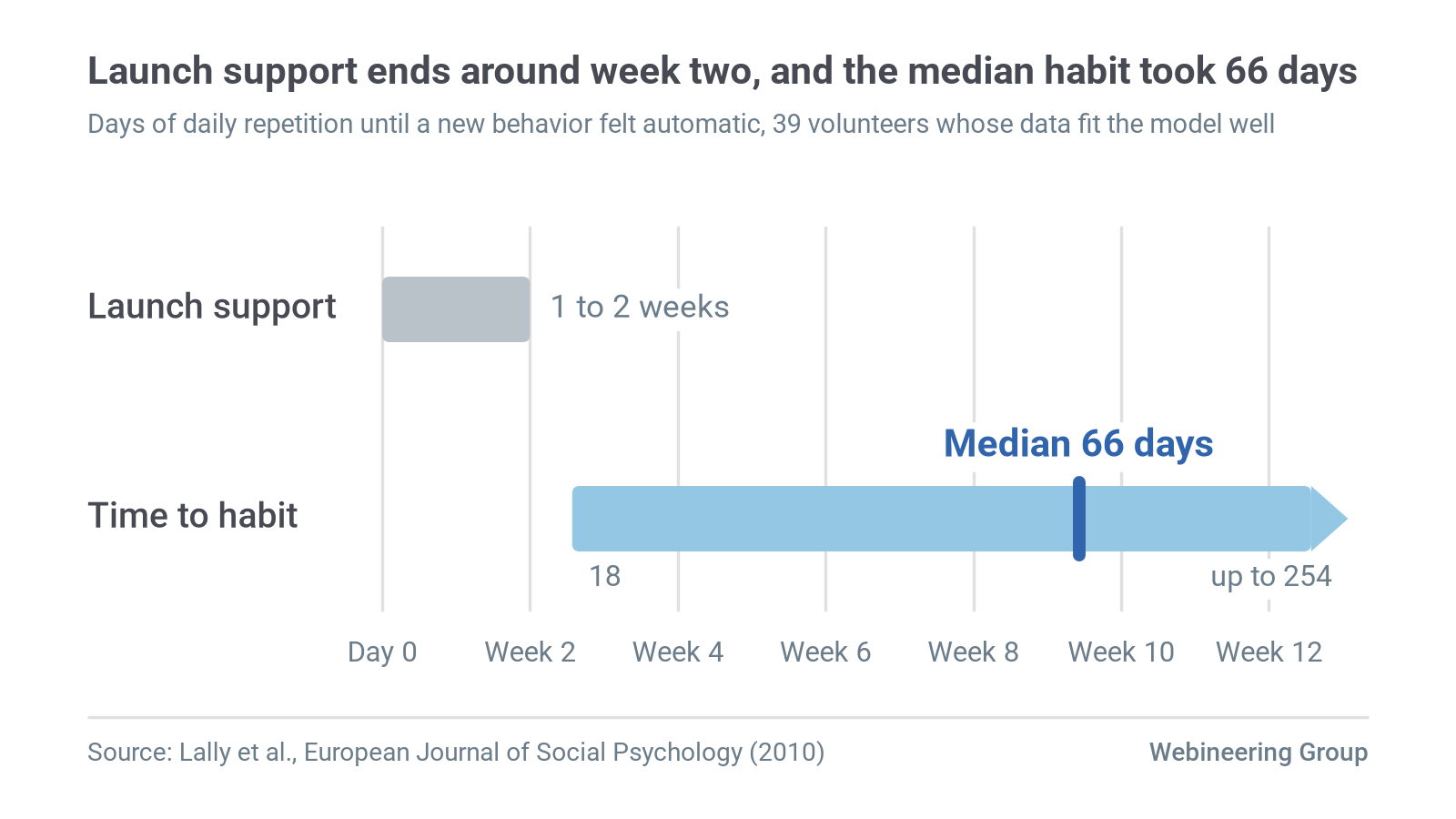
Lally's data also held good news: "Missing one opportunity to perform the behaviour did not materially affect the habit formation process." A skipped board check in week three does little harm by itself. The damage comes when nobody notices the next five.
Launch-week attention works as reinforcement, and it gets pulled all at once
In behavioral terms, the plant manager's presence in week one is reinforcement. Supervisors do the walk, and someone they care about sees it and responds. When that response stops abruptly, the behavior loses its payoff before habit can carry it.
Operant conditioning research describes what follows. Wendy Williams of Central Washington University defines the pattern in Springer's Encyclopedia of Animal Cognition and Behavior (2022). In her words, "behaviors that produce only periodic reinforcement tend to be more resistant to extinction than behaviors that have been reinforced continuously."
This is the partial reinforcement extinction effect. The lab picture has a limit: Guy Hochman and Ido Erev reported in Psychonomic Bulletin & Review in 2013 that partial reinforcement "slowed learning during training and slowed extinction." In plant terms, irregular support too early slows adoption, so the taper belongs after the first two weeks.
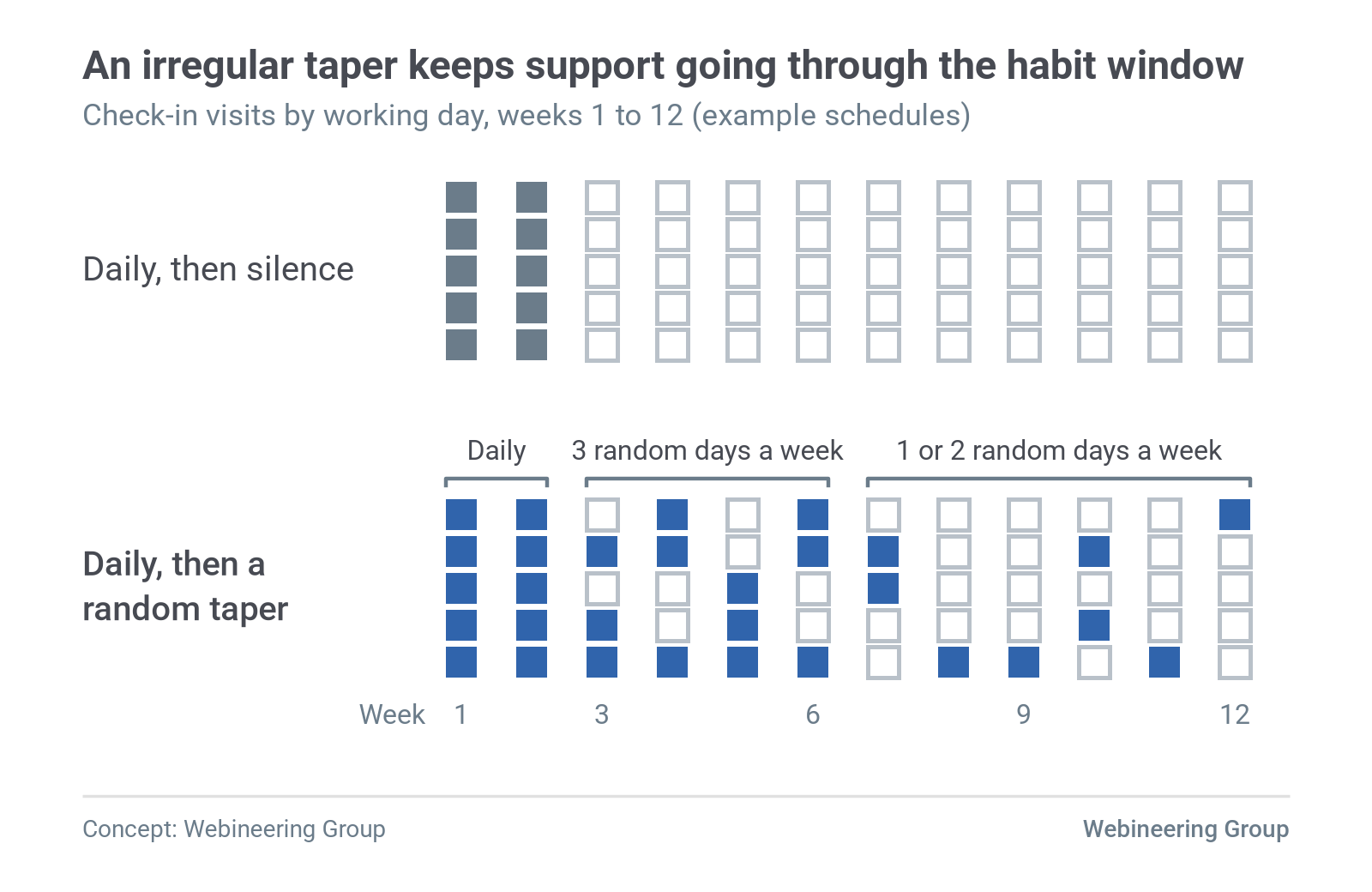
Daily visits followed by silence give the weakest persistence. Daily visits for two weeks, then an irregular taper, build a routine that keeps going through gaps.
Decay after early success has its own literature. David Buchanan and colleagues reviewed it in 2005 in the International Journal of Management Reviews under the title "No going back." Buchanan and Louise Fitzgerald later named a book chapter for the pattern: "Improvement evaporation."
Five changes keep a routine alive through the habit window
- Budget support for 10 to 12 weeks. Put named check-ins on the calendar through week 12 before launch day. Lally's median of 66 days is nearly 10 weeks, and many people take longer.
- Make the new way easier than the old way. Pre-fill the card, keep the routine under 10 minutes, and put the materials where the work happens. Every extra step is a reason to skip on a bad day.
- Attach the routine to an existing cue. Tie the board check to the end of the shift-start meeting or to first-piece approval. In diary studies published in 2002, Wendy Wood, Jeffrey Quinn and Deborah Kashy found that 35% to 43% of participants' daily behaviors repeated almost every day in the same location. Gardner's team uses the term context-dependent repetition for this approach.
- Track adherence as a leading indicator. Count completed routine instances against scheduled ones, per person, every week. Adherence drops weeks before results do, so it gives you early warning.
- Taper check-ins on an irregular schedule. Visit daily for two weeks, then on three random days a week, then once or twice a week at unpredictable times through week 12. Keep a light, random check going after that.
Some routines need a different plan
System-enforced routines don't need a habit. If the manufacturing execution system won't release the next job until the checklist is signed, the interlock carries adherence. Spend your effort checking that the entries are real.
Monthly or quarterly routines can't become habits on a 66-day curve, because they get too few repetitions. Use calendar triggers and named owners for those.
A routine with no value to the person doing it will fade under any schedule. If supervisors see the 2 p.m. board check as paperwork for someone else, fix the routine's purpose first. Reinforcement helps most when the people doing the routine already see what it does for their shift.
Monday
- List every routine launched in the last six months and its completion rate for the last four weeks.
- Schedule named check-ins through week 12 for your next rollout before it starts.
- Cut one step from the hardest routine on the list.
- Attach each daily routine to a cue that already happens at a fixed time.
- Start a weekly adherence count per person, and review it in the tier meeting.
Look at the support plan first
If your routines start strong and fade by the second month, look at the support plan first. Webineering's fixed-fee site assessment reviews your floor processes, records and reports, including how current routines are reinforced and where adherence drops. You get written findings on where support ends too early and what a 12-week plan would need.
Site assessment
Want to see where your own line stands?
An evidence-backed report on where real value lies, from the people who stay through implementation.
About the authors
Alex LaDouceur
Founder
Alex has led Webineering since it started in 2022. At DuPont's Circleville plant he held senior engineering and engineering management roles on the $250 million Kapton and Pyralux expansion, a continuous web line taken from design to qualified production. At Schlumberger he was responsible for assembly, test and refurbishment across deepwater completions product lines.