Data
Shift Handover Report: Design It for the Incoming Supervisor

Anthony Occidentale and Alex LaDouceur
· 8 min read
Most shift reports are written for the record and for the person going off shift, so the incoming supervisor skims them or skips them. Design the handover around what that supervisor needs in the first 15 minutes: current status, what changed, open issues with owners and next actions, decisions waiting, and every safety-critical item. Then pair the page with a short, structured spoken handover. You can do all of it with paper, a spreadsheet, an email or a shared document.
Piper Alpha lost a safety valve between two shifts
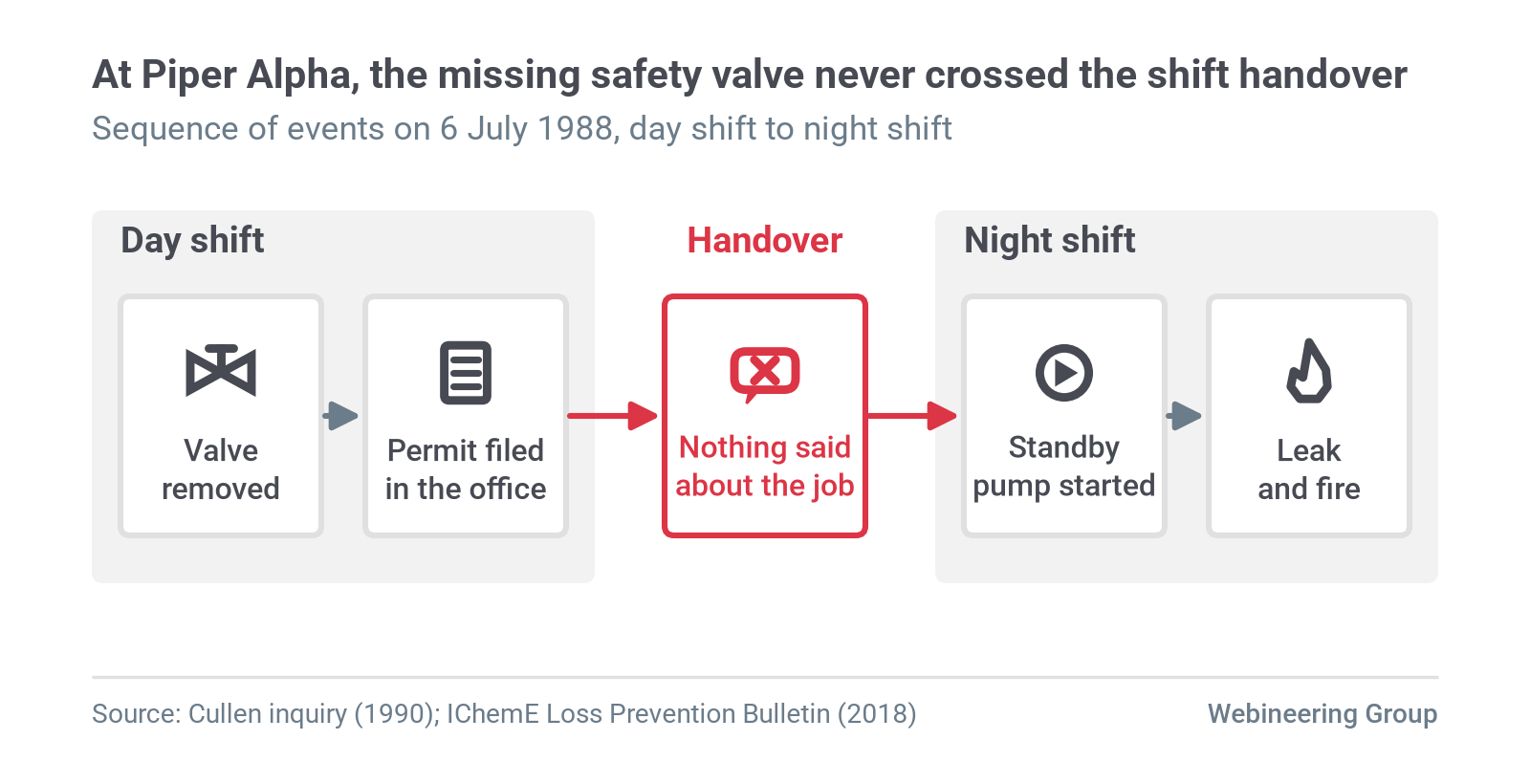
On 6 July 1988, maintenance staff on the Piper Alpha platform in the North Sea removed a pressure safety valve from a standby condensate pump. A blank flange went on in its place, and the job ran past the end of the day shift.
A 2018 account in the Institution of Chemical Engineers' Loss Prevention Bulletin says the maintenance crew returned the suspended permit to the permit office. They did not talk to anyone about the unfinished work.
Late that evening the running pump tripped. The night crew did not find all the paperwork for work on the standby pump, saw nothing about the missing valve, and started it.
Condensate leaked from the flange and ignited, and the fires that followed killed 167 people. Lord Cullen's 1990 public inquiry traced the crew's lack of awareness to two causes. Volume 1 names them as "failures in communication of information at shift handover earlier in the evening and failure in the operation of the permit to work system."
A similar gap opened at BP's Texas City refinery in 2005, 17 years later. On 23 March, the startup of an isomerization unit ended in explosions and fires that killed 15 people and injured 180.
The U.S. Chemical Safety and Hazard Investigation Board (CSB) reported in 2007 that the day supervisor arrived "more than an hour late, and did not conduct shift turnover with any night shift personnel." The board also wrote that "BP had no policy for effective shift communication, nor did it enforce formal shift turnover."
The CSB concluded that operators were likely fatigued from "working 12-hour shifts for 29 or more consecutive days." In both cases the handover failed at one job: getting the current state of the plant into the head of the person taking charge.
Common advice says capture everything, and that breaks at 6 a.m.
Search for "shift handover report template" and most top results come from form, checklist and inspection software vendors. Their templates list fields for production counts, downtime, quality checks, incidents, staffing, maintenance and free-text notes.
The advice is to fill every field, every shift, so nothing gets lost. Complete records matter for audits and investigations.
The trouble starts with the reader. The outgoing supervisor fills the form in the last half hour of a long shift, in the order the form asks. The incoming supervisor reads it in that same order, which can put a suspended permit between a scrap count and a staffing note.
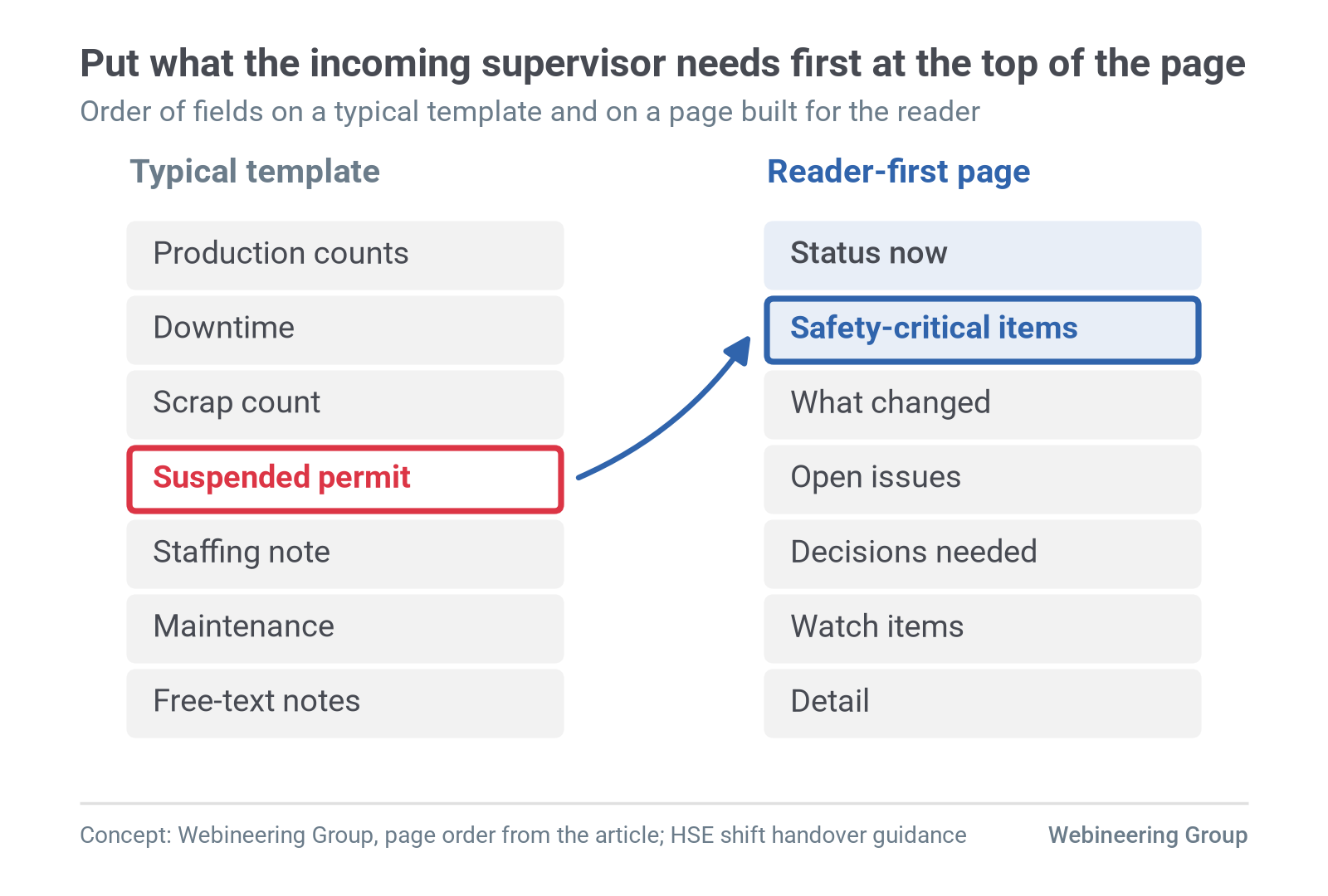
Britain's Health and Safety Executive (HSE) states the design test plainly: handover should be "based on an analysis of the information needs of incoming staff." Most templates are built around the needs of the record, and that mismatch is why the page gets skimmed.
You will also see the claim that 80% of serious medical errors involve handoff miscommunication, credited to the Joint Commission. A November 2010 American Medical News report attributes a version of it to Joint Commission president Mark Chassin, with no published method. This article leaves it out.
The report serves the wrong reader and has no way to answer questions
Three forces push a shift report toward the record. The person writing it is the person least likely to read it again.
The end of a shift is a poor time to write clearly, and the Texas City finding on 29 straight 12-hour shifts is the extreme case. A form that asks for everything also gives no signal about what matters most today.
The incoming supervisor reads in triage mode. They want to know what is running, what is broken, what could hurt someone, and what they must decide before the first break. Put the answers to those four questions on the first screen, where the reader looks first.
A written report also can't respond to a follow-up question. HSE's guidance asks for handover to be "conducted face-to-face," "two-way, with both participants taking joint responsibility," and "done using both verbal and written communication."
A spoken handover on its own has the opposite weakness, because nothing persists once the outgoing supervisor drives home. HSE describes effective handover as three elements: preparation by the outgoing person, the exchange itself, and "cross-checking of information by in-coming personnel as they assume responsibility for the task." Most templates cover only the first element.
HSE also notes that "many accidents have occurred because of failure of communication at shift handover, the majority of these involved planned maintenance work." The same page cites the 1983 Sellafield Beach Incident, when "highly radioactive waste liquor was accidentally discharged to sea, due to a failure of communication between shifts." Open permits and isolations belong to exactly that kind of work.
HSE still points readers to Ronny Lardner's 1996 review, Effective Shift Handover: A Literature Review, published as Offshore Technology Report OTO 96 003. It remains the standard starting point for the industrial evidence.
Clinical handoff research shows what structure buys
Hospitals hand patients between clinicians many times a day, and they have measured what happens when the handover gets a structure. The largest study is I-PASS, published by Amy Starmer and colleagues in the New England Journal of Medicine in 2014.
The team trained pediatric residents at nine hospitals in a handoff program. It paired a structured spoken handover with a matching written summary, backed by training, faculty observation and a sustainability campaign.
Across 10,740 patient admissions, the medical-error rate fell 23%, from 24.5 to 18.8 per 100 admissions. Preventable adverse events fell 30%, from 4.7 to 3.3 per 100 admissions.
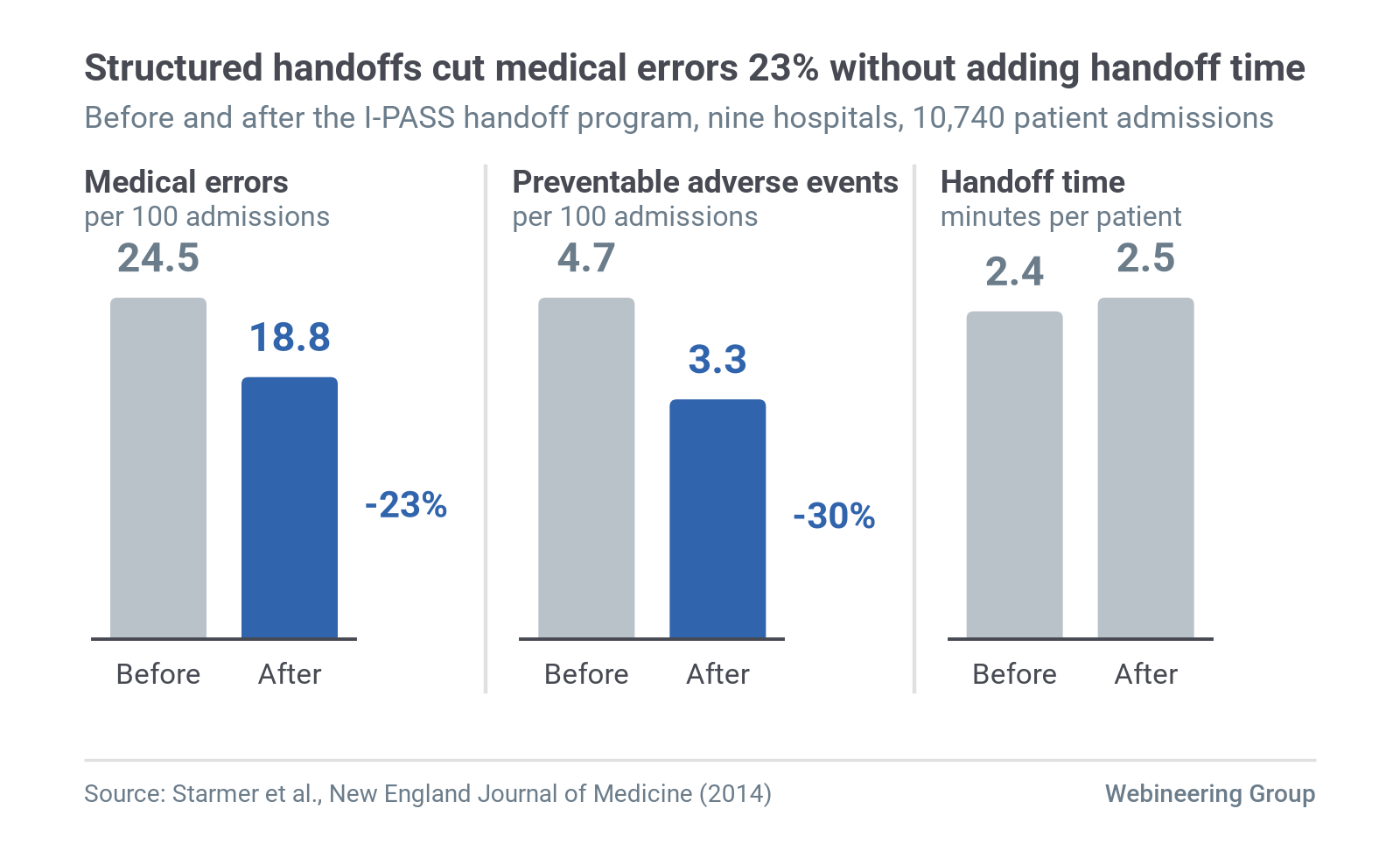
Those are large drops for a change in how people talk.
The authors also reported no negative effect on workflow. Oral handoffs averaged 2.4 minutes per patient before the program and 2.5 minutes after, a difference that was not statistically significant.
Structure did not cost the residents time.
Two limits apply. The study compared periods before and after the program at the same sites, with no randomized control group, and only six of the nine sites showed significant error reductions on their own. It also covered resident physicians in hospitals.
The design lesson still carries over to a plant. The gains came from pairing spoken and written structure, and from ending with the receiver summarizing back. That last step is the final letter of I-PASS, "synthesis by receiver."
High-hazard control rooms worked this out earlier. Emily Patterson and colleagues observed handovers at NASA's Johnson Space Center, nuclear power plants in Canada, a U.S. railroad dispatch center and an ambulance dispatch center in Toronto.
Their 2004 paper in the International Journal for Quality in Health Care checked those observations against 21 handoff strategies. The list includes face-to-face, two-way talk with interactive questioning, limits on interruptions, a receiver review of current data before the exchange, and delayed transfer of responsibility during critical activities.
Each one maps to a field or a step below.
Design the page around the first 15 minutes
Keep the report to one page or one screen, and keep the same headings in the same order every shift. Fill it in as the shift goes, then spend the last 20 minutes checking it. Write "none" when a section is empty, so the reader knows it was checked.
| Field | What goes in it |
|---|---|
| Header | Area or line, date and shift, outgoing and incoming names, time the handover started |
| Status now | One line per line or unit: running, limited or down, and output against plan |
| Safety-critical items | Every open or suspended permit, isolation, bypassed or overridden interlock, inhibited alarm and temporary repair, with location and permit holder |
| What changed this shift | Changes to settings, materials, people, equipment state or the plan since the last handover |
| Open issues | Each issue with one named owner, the next action and when it is due |
| Decisions needed | Choices the incoming supervisor must make, with the deadline and who is waiting |
| Watch items | Conditions to monitor, written as "if this happens, do that" |
| Detail | Where to find the logbook, downtime records, work orders and quality holds |
Safety-critical items sit second on purpose. Piper Alpha's suspended permit sat in an office away from the people who needed it. Put a line on the report for every open permit, and make the incoming supervisor initial each one.
Any of these formats works when the headings keep this order. On paper, use a clipboard sheet with the headings preprinted. In a spreadsheet, use one tab per shift with the headings frozen at the top.
In email, put the status line in the subject. In a shared document, copy the same template for every shift and never reorder it.
Run the spoken handover to a fixed 15-minute agenda
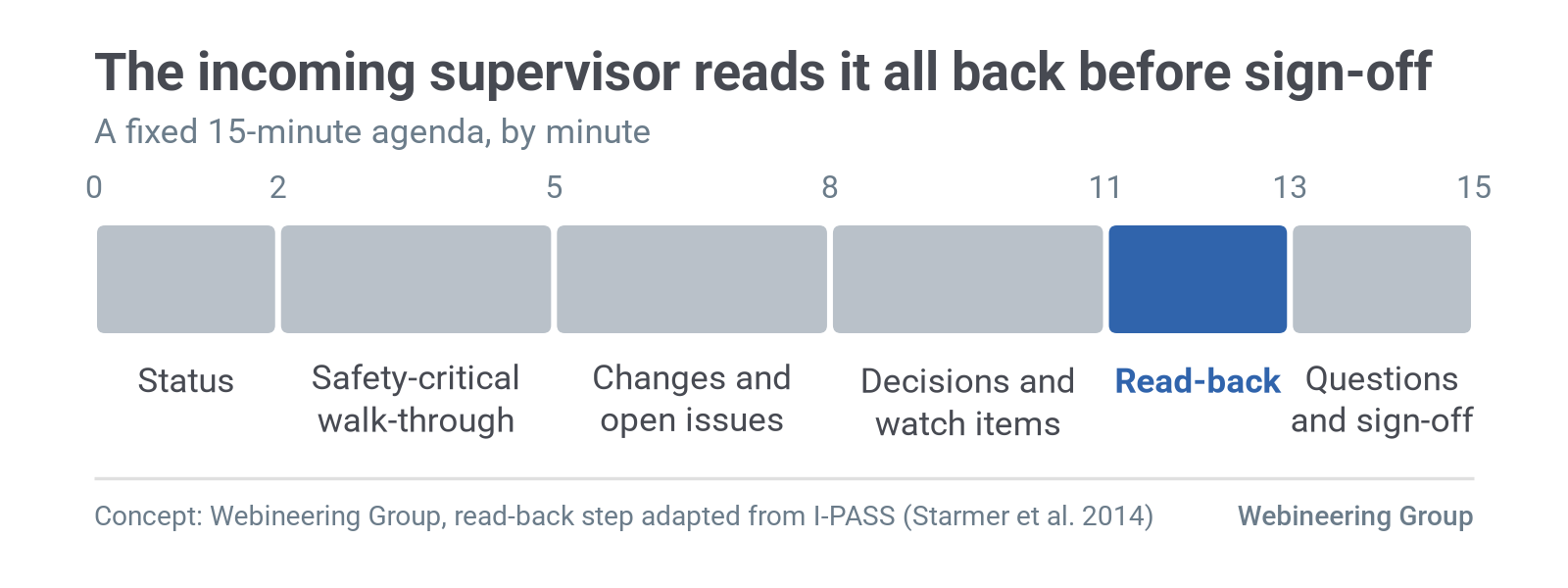
- Minutes 0 to 2: The outgoing supervisor reads the status line for each area.
- Minutes 2 to 5: Walk through every safety-critical item at the permit board or panel. The incoming supervisor checks each one against the board and initials it.
- Minutes 5 to 8: Cover what changed and each open issue, naming the owner and the next action.
- Minutes 8 to 11: Hand over decisions needed and watch items, with deadlines.
- Minutes 11 to 13: The incoming supervisor summarizes back the status, the safety-critical items and their first three actions. The outgoing supervisor corrects anything wrong.
- Minutes 13 to 15: Take questions, then both sign the sheet and responsibility transfers.
If a critical activity is mid-step at handover time, the outgoing supervisor keeps responsibility until it reaches a safe hold point. That is the delayed transfer Patterson's team observed, in plant terms.
HSE asks organizations to identify higher-risk handovers and to give handover "as much time and resource as necessary." Startups, shutdowns, maintenance carried across shifts and the first shift back after leave are obvious candidates. At those handovers, plan for longer than 15 minutes and do the walk-down on the floor.
These conditions call for a different handover
Single-shift sites with no overlap. When nobody is there to receive the handover, the spoken half can't happen. Use the same written page, and add a start-of-shift check where the first supervisor in confirms each safety-critical item before restarting anything.
Handovers already governed by a formal system. Permit-to-work systems and pharmaceutical batch records often prescribe what must be handed over and who signs. Keep those records as the authority, and use this page to point the incoming supervisor to them.
Very short absences inside one shift. A supervisor covering a 30-minute break needs the status line and the safety-critical items. The full agenda adds time without adding much safety.
Start on Monday with these steps
- Pull the last 10 shift reports and mark where each permit, isolation or bypass appeared on the page.
- Ask two incoming supervisors what they look for first, and write their answers down.
- Reorder your current form so status and safety-critical items come first, without buying anything.
- Add a "Decisions needed" field and a "none" convention for empty sections.
- Time the next five handovers and note which ones ran without a read-back.
- Add the read-back step and the joint signature to your handover procedure.
- Review the new page with both shifts after 30 days and cut any field nobody used.
A site assessment shows where your handovers leak
Webineering's fixed-fee site assessment reviews floor processes, records and reports, which can include your shift logs and handover practice. You receive a written findings report that ranks the gaps we observed and recommends specific fixes. Get in touch to schedule one.
Site assessment
Want to see where your own line stands?
An evidence-backed report on where real value lies, from the people who stay through implementation.
About the authors
Alex LaDouceur
Founder
Alex has led Webineering since it started in 2022. At DuPont's Circleville plant he held senior engineering and engineering management roles on the $250 million Kapton and Pyralux expansion, a continuous web line taken from design to qualified production. At Schlumberger he was responsible for assembly, test and refurbishment across deepwater completions product lines.