Operations
How to Write Work Instructions Your Newest Operator Can Use

Anthony Occidentale and Alex LaDouceur
· 3 min read
Expertise hides steps. Once a task runs on autopilot, the expert stops noticing many of the decisions a newer operator still has to make. Instructions written by your top performer often fail the average operator on exactly those decisions.
Three surgeons left out half of a colonoscopy
In 2008, Maura Sullivan and colleagues at the University of Southern California videotaped three expert colorectal surgeons teaching a colonoscopy. They then used cognitive task analysis, a structured interview method for drawing out what experts know, to build a 26-step checklist and a 16-item list of decisions.
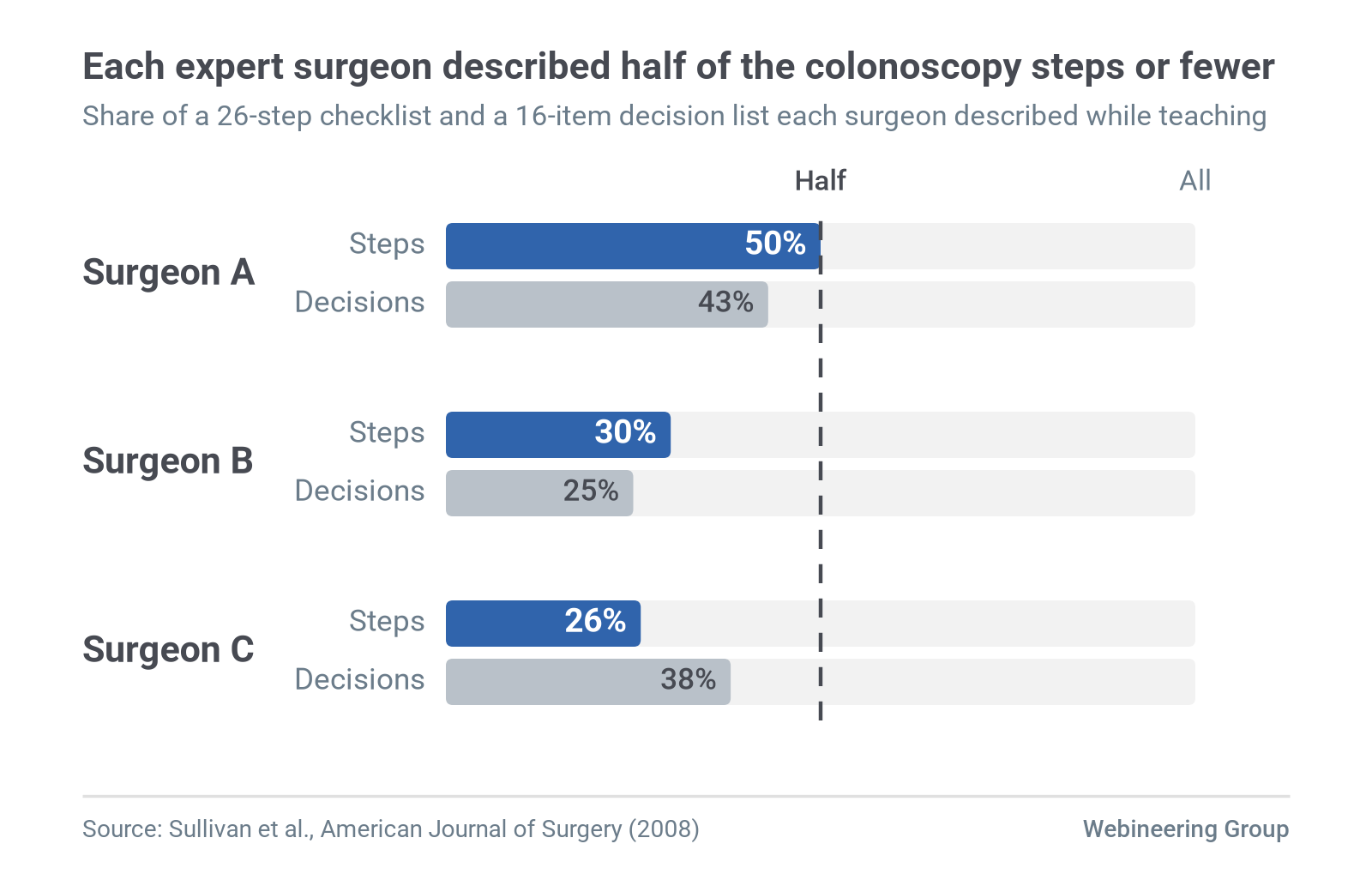
Surgeon A described 50% of the how-to steps and 43% of the decisions. Surgeon B described 30% and 25%, and Surgeon C described 26% and 38%. Each experienced specialist left out at least half the steps.
Asking the expert to write it is the default, and it misses the decisions
Most top-ranking guides on writing work instructions come from software vendors. They advise a clear title, short steps, visuals and review by a subject matter expert. None deals with what the expert can no longer see.
The omissions repeat in other studies. Richard Clark and colleagues asked four trauma surgeons to describe a femoral artery shunt from memory, and those surgeons "omitted nearly 70% of necessary decision steps" (Journal of Surgical Research, online 2011, print 2012).
In a 2014 Academic Medicine study led by Sullivan, three experts videotaped teaching cricothyrotomy omitted an average of 71% of clinical knowledge steps, 51% of action steps and 73% of decision steps.
The often-quoted rule that experts omit 70% of what novices need comes from this one research group and small surgical samples. Treat it as a strong pattern, and quote the study numbers when precision matters.
Automatic skill hides the decisions
Practice moves a skill out of conscious attention. The expert still makes the decision, but it no longer feels like a decision.
Economists Colin Camerer, George Loewenstein and Martin Weber named this bias the curse of knowledge in the Journal of Political Economy in 1989. Stanford psychology graduate student Elizabeth Newton showed it in her 1990 dissertation, as Chip and Dan Heath reported in Harvard Business Review in December 2006.
Newton's tappers drummed the rhythm of well-known songs and predicted listeners would name 50% of them. Listeners named 3 of 120, or 2.5%. On the floor, the expert is the tapper and the new operator is the listener.
A second person writes while the expert works
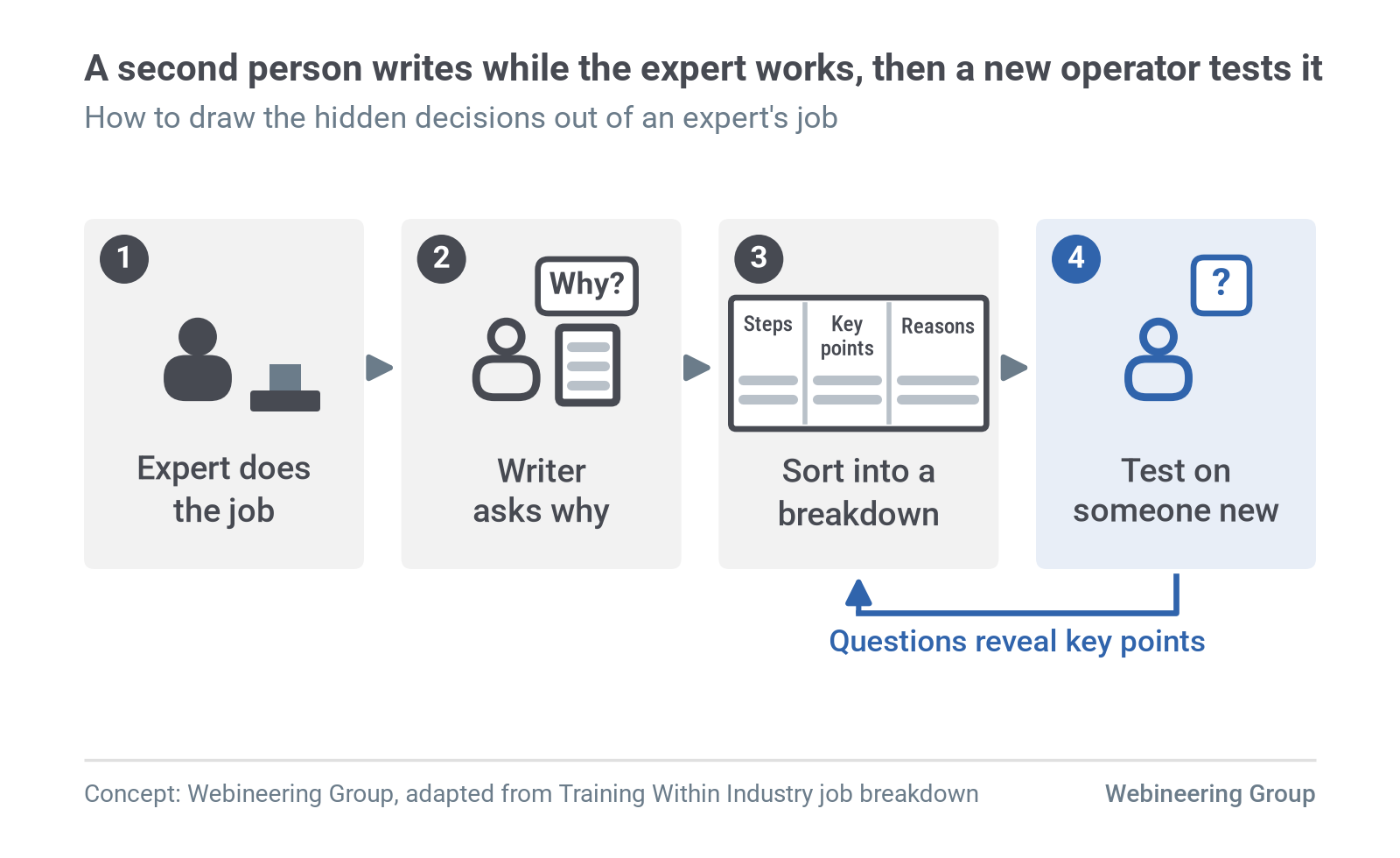
- Have the expert perform the task at the station, at normal speed, on real parts.
- Have a less experienced person write each step and ask "why?" at every pause, adjustment or glance.
- Sort the notes into a Training Within Industry (TWI) job breakdown: important steps, key points and reasons. TWI defines key points as anything that could make or break the job, injure the worker or make the work easier.
- Test the draft on someone new while the expert watches silently. Each question the new person asks marks a missing key point.
Training Within Industry, run by the War Manpower Commission from 1940 to 1945, taught the standard plainly: "If the worker hasn't learned, the instructor hasn't taught." The same test applies to the written instruction.
Simple tasks and recent learners gain little from this
One-motion tasks with no judgment, such as loading a fixture that only fits one way, have little hidden knowledge. The fixture already holds the key point.
The method also adds little when the writer learned the task recently. A newly qualified operator still remembers the confusing parts and can often write them down directly. Test the draft on someone new either way.
Monday
- Pick the work instruction tied to your most frequent new-hire error.
- Pair your top operator with your newest qualified operator for one 30-minute breakdown session.
- Rewrite the instruction as important steps, key points and reasons.
- Test it on someone who has never done the job, and log every question they ask.
Find where the written steps drift
If new operators keep making the same mistakes with instructions in hand, the instructions may be missing the expert's decisions. Webineering's fixed-fee site assessment reviews how work is done, documented and taught on your floor. That review can show where the written steps and the real job drift apart before the next new hire finds the gap.
Site assessment
Want to see where your own line stands?
An evidence-backed report on where real value lies, from the people who stay through implementation.
About the authors
Alex LaDouceur
Founder
Alex has led Webineering since it started in 2022. At DuPont's Circleville plant he held senior engineering and engineering management roles on the $250 million Kapton and Pyralux expansion, a continuous web line taken from design to qualified production. At Schlumberger he was responsible for assembly, test and refurbishment across deepwater completions product lines.