Lean
Map the Work as It Happens on the Floor


Anthony Occidentale and Alex LaDouceur
· 3 min read
A current state value stream map is worth drawing only when it records what people do at each step. Procedures and floor practice drift apart, and a map copied from the procedure hides the gap you most need to see.
A text message is the real handoff
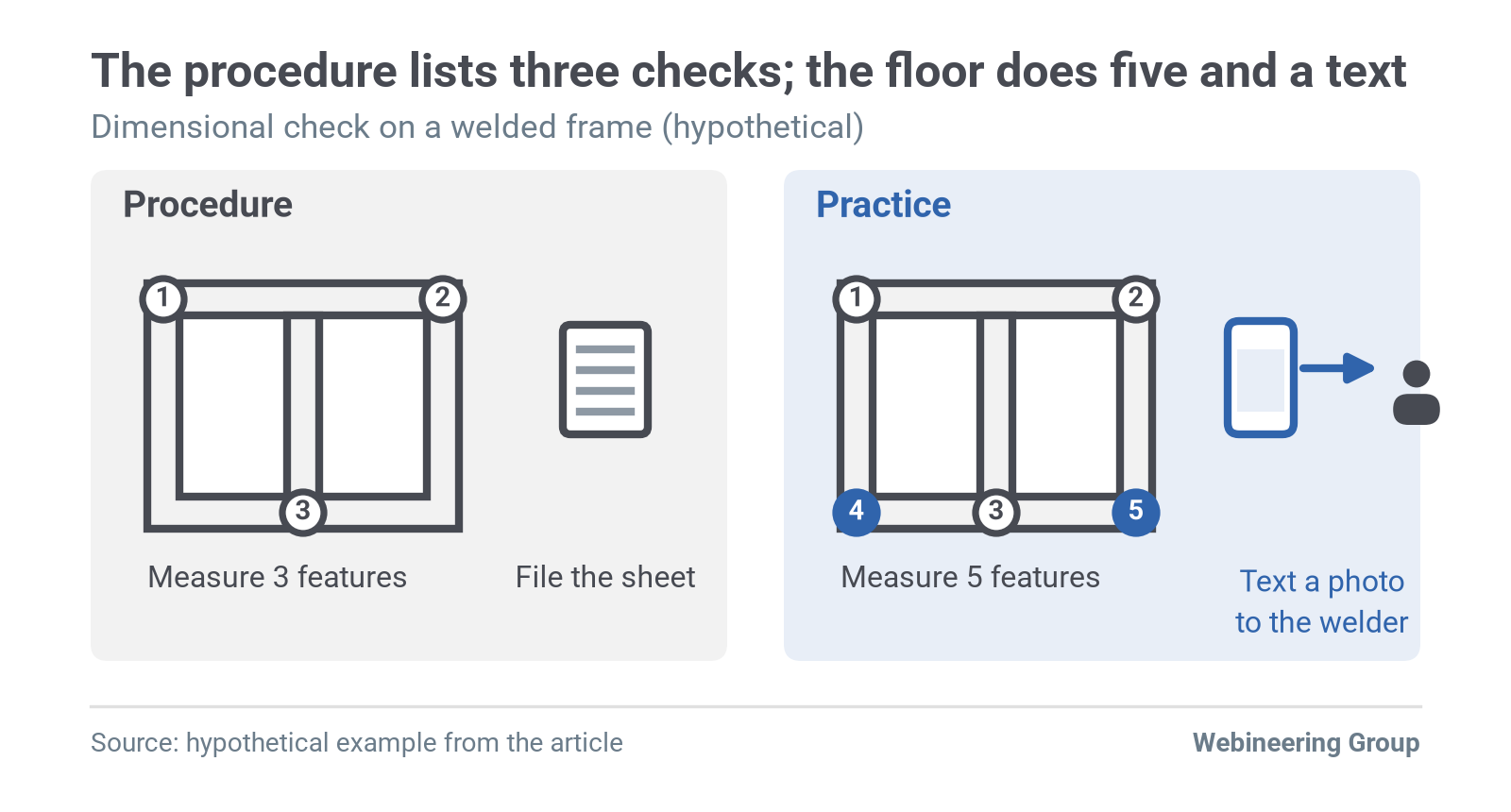
Picture a hypothetical dimensional check on a welded frame, where the procedure says to measure three features and file the sheet, but the inspector measures five and texts a photo to the welder.
The two extra features catch a fixture that drifts, and the text message is the real handoff, though no document mentions it. A map drawn from the procedure shows one clean step and misses both.
Procedure-based maps record intention
Teams often draw the first map from the procedure or from memory in a conference room. Severino Abad wrote in Planet Lean in 2019 that one of the hardest parts of mapping is telling apart "how things happen", "how we say things happen" and "how things should happen". The procedure records the third, and Abad also describes a person he calls Manolo, whom no procedure names. When Manolo is on holiday, the process "works in a completely different way or doesn't work at all."
Dan Markovitz, in an October 28, 2020 post on his consulting blog, tells teams to "walk through the value stream to see how the work actually flows through the company."
A current state value stream map built from the walk
- Print the procedure for one flow and take it to the floor.
- Walk the flow with the people who run it. The Rolls-Royce supplier guide (2020) tells suppliers to confirm the actual process by walking the value stream.
- Mark each step where practice differs from the procedure, in the words the operator uses.
- Record the information flow: who tells whom, and by what channel. Abad recommends swimlane diagrams, also called makigami, for mapping information flows across functions.
- Name the person whose absence changes the flow, and note what they do that nobody else does.
- Count the actual inventory in front of each step. Rui Sousa, José Dinis-Carvalho and Peter Hines list inventory quantification among six recurring mapping problems in Production Engineering Archives in 2026.
- Decide for each gap whether the practice or the procedure is right. Fix the loser before you draw the future state.
Keep the gaps on one sheet, one row per step:
| Step | Procedure says | Practice does | Who and channel | Which wins | Action |
|---|---|---|---|---|---|
| Dimensional check | Measure three features, file the sheet | Measures five, texts a photo to the welder | Inspector to welder, by text | Practice | Add features four and five and the welder alert to the procedure |
When the practice wins, rewrite the procedure. Pick one mandatory word for your procedures, then write work instructions your newest operator can use. When the procedure wins, retrain and recheck in two weeks.
Three settings need a different routine
- Regulated controls. Under Food and Drug Administration, Federal Aviation Administration or International Traffic in Arms Regulations rules, deviations go through change control before anyone maps them as the new standard.
- Highly automated cells. Map from machine and system logs, since there's little hand practice to watch.
- Union or safety settings. Agree on observation with workforce and safety leads before the walk.
Start these five on Monday
- Print the procedure for one flow and take it to the floor.
- Walk it with the people who run it, at the time they normally run it.
- Mark each step where practice differs, and note who told you.
- Name the person whose absence changes the flow, and note what they do that nobody else does.
- Count the inventory in front of each step, by hand, on the day you walk.
Get procedure and practice side by side
Webineering's fixed-fee site assessment reviews floor processes, records and reports for one value stream, and its one written report compares the written procedure with observed practice at the steps we walk.
Site assessment
Want to see where your own line stands?
An evidence-backed report on where real value lies, from the people who stay through implementation.
Authors
Anthony Occidentale
Principal
Founder